Unclouding the Ecovacs O500
Root access, TLS interception, and the path to local control
Philipp A. Baer
October 26, 2026
About
Computer Science · Security · DevSecOps · Robotics
- Research: Dr.-Ing. Kassel University; distributed systems and cooperative robotics.
- Robotics: RoboCup in Ulm and Kassel; Robotics at DFKI RIC Bremen.
- Today: Software architecture, security, and infra/DevSecOps at GE HealthCare.
Keep things local
I try to keep things off the cloud as much as possible.
- Local services: Home Assistant, ESPHome, Frigate for video, Forgejo for Git.
- Unclouded devices: Dreame vacuum with Valetudo; Sonoff NSPanel with NSPanelEasy.
- Open-source projects: WallDisplay · WaterRower Local BLE.
One device remains to uncloud: the Ecovacs O500 Panorama.
The Ecovacs O500 Panorama
What would it take to make an owner-controlled mower work without Ecovacs services?
- Primary goal: control the robot locally (start, stop, and status).
- Secondary goal: local map storage and retrieval, add a Bumper-like service [2].
- Maybe future: local video streaming (it has a separate Kinesis / STUN / ICE path).
Understand the TLS and MQTT paths, authentication / topic semantics, firmware and boot chain. Get a root shell on the device first.
Broke the debug interface in the process. Mower is still functional, UART echo prevents reliable command execution.
IMAGE SLOT · Ecovacs O500 Panorama in the yard; landscape photo
Cloud control: what we observed
Android · Frida observed
POST /api/iot/endpoint/control[1]Android · 0.0.22 · start/stop · auto- Auth and response not captured.
Home Assistant · working
- GOAT O500 (
300lc5) via Ecovacs MQTT [1, 3]. - GOAT command topic:
iot/p2p/clean[3].
Inferred: Android API-to-MQTT handoff.
Cloud control: connection overview
| Path | Endpoint type | Route | Finding |
|---|---|---|---|
| App control | HTTPS API | Android → NG-IoT | Frida observed POST Response not captured |
| HA control | MQTT over TLS | Home Assistant → Ecovacs MQTT → O500 (300lc5) |
Control works through Ecovacs cloud |
| Video | Kinesis + STUN/ICE | O500 → video services | Separate cloud path |
Still inferred: app API → MQTT handoff [1].
Untested: control with Ecovacs services unavailable.
The mobile app
Test setup: Rooted Android (LineageOS) · ECOVACS HOME 3.14.0 · Frida [1]
Control API: POST api-ngiot.dc-eu.ww.ecouser.net/api/iot/endpoint/control [1]
Observed envelope: header.m=request · header.channel=Android · header.ver=0.0.22
Probe:
- TLS 1.3, Let’s Encrypt certificate.
- App trust remains untested (pinned or not). No client certificate or private key found.
- Body-level authentication unknown (no header names visible at OkHttp hooks)
The mobile app: Start/Stop request shape
Frida observed the app constructing this request shape. The API itself was not tested, and no response was captured.
Other observed body.data keys: name, schedAct, sid, subsets, using (values withheld).
Analysis paused
- Home Assistant as well as the robot itself interact only via MQTT.
- Is the IoT API worth being inspected at all?
The mobile app: What public research adds
- Working O500 path: Home Assistant controls the GOAT O500 via MQTT, class
300lc5[1, 3]. - GOAT-specific Home Assistant integration [3]
- Send control to
iot/p2p/clean, notiot/p2p/clean_V2 - Handles pushed charge and schedule state.
- Send control to
- 2025 community capture: same
/api/iot/endpoint/control,clean_V2request family [4]. - It records
start,pause,resume,stop, andgo(iOS, China-region).
The Android app’s HTTPS endpoint remains a Frida request-shape finding [1]. Ecovacs’ Open Platform documents a separate API [5].
Find the console
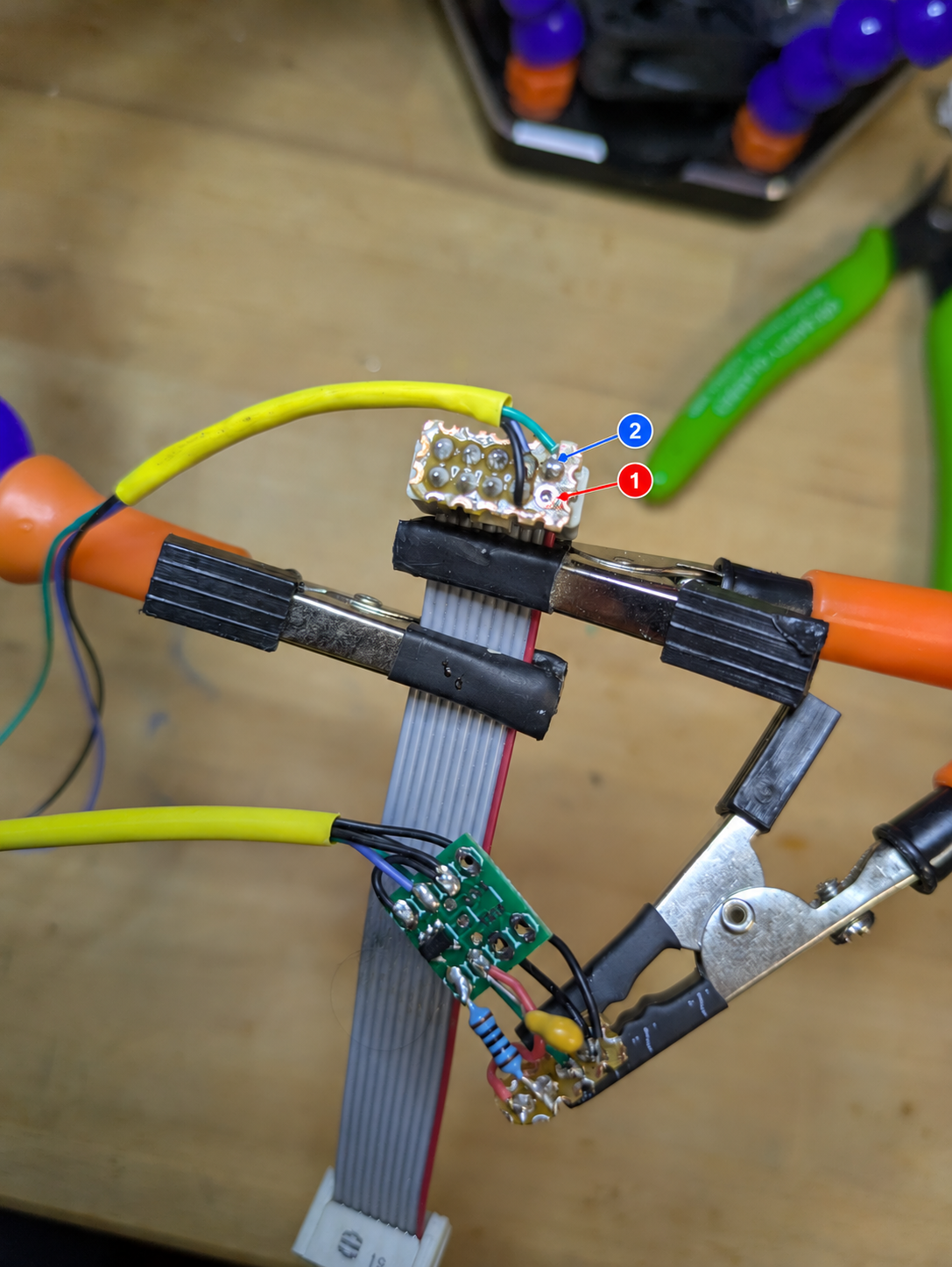 Debug Head (Robot) UART adapter (PC)
10-pin header
| Pin | Function |
|---|---|
| 1 | 3.3 V rail |
| 2 | X5 UART TX |
| 3 | GND |
| 4 | X5 UART RX |
| 7 | Baize UART TX |
| 8–9 | Unassigned |
| 10 | 1.8 V rail |
Inside the firmware
U-Boot selects an A/B slot and verifies it [1, 6].
system_a/bis read-only under dm-verity [1, 6]/datais a separate writable userdata partition [1].
Test 1: Temporary boot parameter
Question: can Linux start a maintenance shell from a one-boot kernel argument?
- U-Boot: append
init=/bin/shto the boot arguments temporarily in RAM. - Boot the known
_aslot withhb_avb_helper.
We skipped eco_ab_select to avoid updating the A/B boot-attempt record.
Outcome: no shell obtained
UART echoed id and Ctrl-C, but returned no prompt or command output. The echo does not confirm that the shell started. No flash or boot files changed; power-cycle restored the normal environment [1].
Test 2: use the bundled recovery image
boot_a is a FIT bundle with two boot configurations [1, 8]:
| Configuration | Contents |
|---|---|
boardid-0x2000 |
Normal mower boot |
boardid-0x010202 |
x5-evb-v2-recovery with a ramdisk |
We loaded boot_a into RAM at 0x90000000, then selected recovery:
This ran the bundled recovery configuration for one boot; it did not install a new bootloader or write the image to flash.
Neither temporary boot gave us a shell
The init=/bin/sh attempt echoed id and Ctrl-C, but returned no prompt or command output.
The recovery configuration gave no UART output, USB device, or normal LAN address.
These tests were inconclusive—not root access. Power-cycle restored normal boot.
Find the boot hook from U-Boot
Read-only inspection: we examined selected files on system_a at U-Boot to trace the startup sequence [1]. No full image dump or system-partition write was involved.
U-Boot tools: ext4ls lists files; ext4load reads them into RAM; md.b displays bytes.
Files inspected:
autostart.service · /usr/bin/autostart.sh
serial-getty@.service · /usr/bin/serial_tty.sh
What they showed:
autostart.serviceruns after ROS and invokes/usr/bin/autostart.sh.- The script launches
/data/autostart/*.shwithstartin the background. - No
User=override: the system service runs as root.
Why serial login was unavailable
The boot log: serial-getty@ttyS0 started, then stopped. No login prompt [1].
On system_a, serial-getty@.service calls /usr/bin/serial_tty.sh:
The marker enables agetty but supplies no credentials. I left it absent.
The root shell uses a separate hook: /data/autostart/*.sh, launched after ROS [1]. Neither this hook nor its installation depends on the failed boot-parameter experiment.
Export userdata over USB
Reach U-Boot (UART)
- Interrupt autoboot over serial and wait for
Hobot> - Send
ums 1 mmc 0:10at the prompt [1].
Export userdata (USB)
- U-Boot presents the eMMC filesystem as USB mass storage.
- The host detected a 10.5 GiB ext4 disk at
/dev/sda.
Install the hook (USB)
- Mount the disk on the host
- Copy the startup script,
syncand unmount before stopping UMS.
Successful route to the root shell
- Reach U-Boot: connect UART and interrupt autoboot at
Hobot>[1]. No boot-parameter change is needed. - Install the hook: run
ums 1 mmc 0:10. Mount the exported ext4 userdata on the host; copyo500/tools/goat_serial_bootstrap.shtoautostart/10-serial-root.sh, set mode0700, then sync and unmount cleanly. - Boot normally: after ROS starts,
autostart.serviceruns the script as root. It stops serial-getty, configures/dev/ttyS0, and launches Bash. Verify:GOAT# id→uid=0(root).
Separate failed test: init=/bin/sh is unrelated. UMS mapping is firmware-specific. The hook persists in /data; remove it through UMS.
ADB was not a useful route
After the root-shell path was established, the USB-A port was checked: it enumerated as hobot / xj3, but ADB remained unauthorized [1].
No ADB shell or filesystem commands were attempted; this route was not investigated further.
Get Hydra talking locally
Hydra is the mower process that connects to Ecovacs’ MQTT endpoint [1].
- Endpoint:
jmq-ngiot-*. - Hydra config option
mqCapoints to a writable TLS trust file:/data/certs/master.pem.
We redirected the MQTT endpoint to a local TLS listener (signed by a short-lived test CA) and placed both certificates (Ecovacs, ours) in /data/certs/master.pem:
- ❌ Ecovacs CA first: TLS handshake failed.
- ✅ Test CA first: TLS 1.3 handshake succeeded.
Restored the original trust file, removed the redirect. MQTT authentication or commands not tested.
MQTT framing observed
With the TLS trust path established, our metadata probe acted as a permissive MQTT peer, not a full broker [1]:
- It accepted Hydra’s MQTT 3.1.1
CONNECTwithout checking the username/password. - It did not request a robot client certificate; the live Ecovacs endpoint does.
- Hydra sent four QoS-1 subscriptions; the probe acknowledged them.
Implication: a local broker can skip Ecovacs client-certificate and MQTT credential checks. Bumper supports a dedicated MQTT listener, but O500 compatibility has not been tested [2].
Still unknown: command and status topics, payloads, and a working start/stop/status loop. The stock app’s HTTPS API is separate.
UART RX failure ended this test run
Before the interruption
- We installed a
/data/autostartbootstrap and verified a root shell on normal boot. - We redirected Hydra to a local TLS/MQTT probe and observed
CONNECTplus four subscriptions.
Then: UART RX stopped accepting commands. Normal boot still reached GOAT#, but commands returned no output. The echo source and electrical cause remain unverified [1].
Open question: Bumper supports a dedicated MQTT listener, but O500 topic and status handling have not been tested [1, 2].
What we proved and what remains
Proven
/data/autostartyields a root shell.- Successful local TLS 1.3 handshake.
- A stub MQTT peer
- accepted
CONNECT, - acknowledged four subscriptions,
- skipped AuthN/AuthZ.
- accepted
Still unknown
- MQTT command and status topics and payloads.
- Whether Bumper can work with the O500.
- Whether local start, stop, and status are possible.
- How the stock app hands off to MQTT; its API is separate HTTPS.
Afterward: RX damage blocked maintenance access
The earlier UART setup reached U-Boot, accepted commands, and enabled the root-shell installation. After the RX pin was damaged, maintenance input stopped working.
Normal boot still reaches GOAT#, but id produces matching bytes on the adapter RX without visible command output. The echo source is unverified; the command may not be reaching Bash.
The bootstrap remains installed. UART cannot currently remove it, UMS cannot be started, and USB ADB remains unauthorized [1].
Questions
What result would change your mind about local control?
Literature · research & community
- [1] Philipp A. Baer. Ecovacs GOAT O500 research log. Field notes, captures, firmware inspection and test results; updated 26 Oct 2026.
- [2] Brian Martin. “How does Bumper work?”. Bumper project documentation, GitHub; describes its emulation of Ecovacs cloud services and observed XMPP/MQTT paths. Accessed 26 Oct 2026.
- [3] Rickard Nord. Ecovacs Mower for Home Assistant. Open-source integration, GitHub; GOAT-specific MQTT commands and state handling. Accessed 26 Oct 2026.
- [4] MatterXiaomi.com. “Part5 - ecovacs: Vacuum cleaner commands”. Blog post, 4 Jun 2025; community examples of
clean_V2requests.
Literature · platform & specifications
- [5] Ecovacs Robotics. Ecovacs Open Platform. Official developer portal; consulted 26 Oct 2026. Its public API is distinct from the private NG-IoT endpoint discussed here.
- [6] D-Robotics. X5 Chip User Manual, v2.0.0, §4.4.9.1 “OTA Functionality and Introduction”. Platform reference for OTA and A/B partitions; not evidence of the O500’s exact configuration.
- [7] Dennis Giese and Braelynn Hacker. “Reverse engineering and hacking Ecovacs robots”. DEF CON 32 presentation, 2024; GOAT G1 research, with different hardware from this O500.
- [8] Marian Balakowicz, Bartłomiej Sieka, and Simon Glass. Flattened Image Tree Specification, v1.0. Open Source Firmware Foundation, 11 Apr 2026; FIT image components and configurations.
Slide deck changelog
- 26 Oct 2026 · feat: Generate deck changelog and align graph typography (#35)
- 26 Oct 2026 · fix(o500): open slides outside VitePress client router (#34)
- 26 Oct 2026 · feat: add walldisplay, revise home, improve o500 presentation (#33)
- 10 Oct 2026 · fix: open the title slide directly (#29)
- 26 Sep 2026 · feat: improve site and integrate o500 research (#27)